
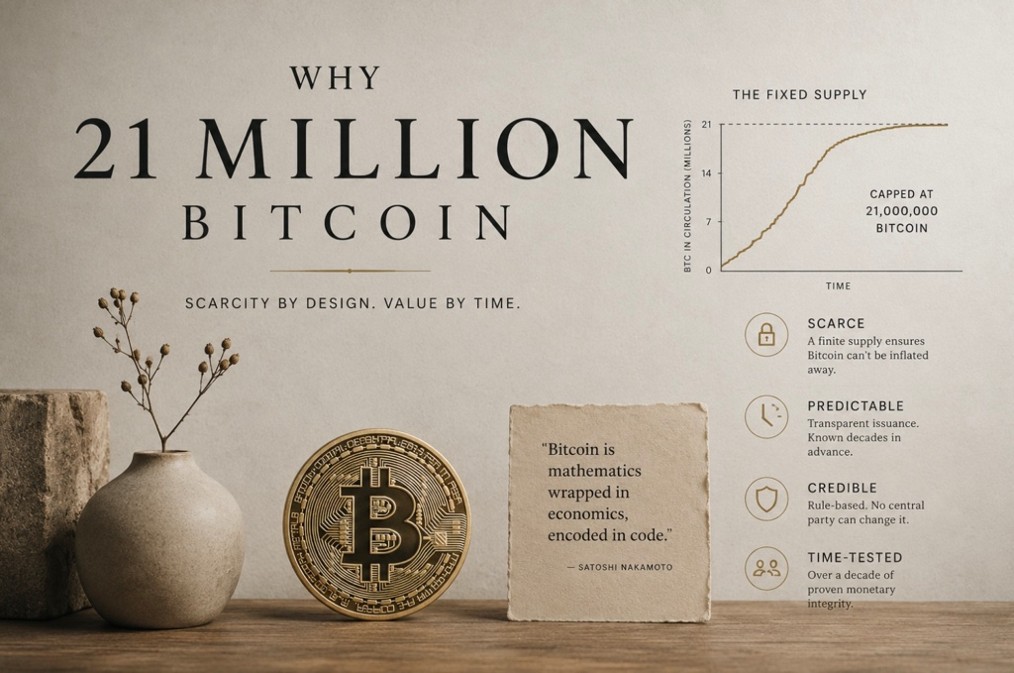
The number matters less than you think. The limit matters enormously though!
Why are there only 21 million? It sounds strangely arbitrary. Why not 20 million? Or 100 million? Or one billion?
Did Satoshi Nakamoto arrive at 21 million through some elaborate mathematical calculation? Is there something economically perfect about the number?
Not really.
The number itself is far less important than what it represents.Bitcoin introduced something we had never really possessed before: a digital asset with a supply that is known in advance, independently verifiable and extraordinarily difficult for anyone to change.
To understand why that matters, we first need to understand where the 21 million comes from.
Bitcoin wasn’t issued all at once
When Bitcoin began operating in January 2009, new bitcoin were issued as part of the reward received by miners (computers crunching numbers for an outcome) for successfully adding blocks of transactions to the Bitcoin blockchain.
Initially, that reward was 50 bitcoin per block.
Approximately every four years or more precisely, every 210,000 blocks the amount of new bitcoin issued per block is cut in half.
So the issuance schedule has looked like this:
50 then 25 then 12.5, 6.25, 3.125 and so the process will continue 1.5626, 0.78125 and so on.
Mathematically, these progressively smaller rewards form a geometric series whose total approaches but never exceeds 21 million bitcoin, The final fractions of new bitcoin are expected to be issued (mined) around the year 2140.
That is where the famous 21 million comes from.
But why 21 million?
There are various theories about why Satoshi chose the particular parameters that produce roughly 21 million bitcoin. They’re interesting. But they’re also somewhat beside the point.
Satoshi could theoretically have designed Bitcoin around 42 million coins, or 10 million, or 100 million. If all the other rules had been adjusted proportionately, Bitcoin wouldn’t necessarily have been more or less scarce.
Why?
Because the size of the unit is arbitrary. Imagine a pizza.

You can cut it into eight slices or 32 slices. You haven’t created more pizza. You’ve simply changed the size of each piece. Bitcoin works in much the same way.
One bitcoin can be divided into 100 million smaller units, called satoshis or sats.
That means the Bitcoin network ultimately contains roughly 2.1 quadrillion satoshis.
So when somebody says: There aren’t enough bitcoin for everyone. They’re confusing the number of whole bitcoins with the number of available monetary units.
Nobody needs to own an entire bitcoin any more than somebody needs to own an entire kilogram of gold. You simply own a fraction.
Scarcity is the important part
This is where Bitcoin becomes more interesting. Throughout history, humans have repeatedly searched for things that are difficult to produce as stores of wealth.
Shells – Salt – Silver – Gold – Land.
The problem is that scarcity tends to create its own response.
If the price of gold rises significantly, miners have a greater incentive to search for gold, develop marginal deposits and invest in new extraction technology. More supply eventually comes to market.The same principle applies to almost every commodity.
Bitcoin behaves differently.
If the price of Bitcoin doubled tomorrow, miners could deploy vastly more computing power to the network. They could build enormous mining facilities. They could consume considerably more electricity.
But they could not make Bitcoin’s predetermined issuance schedule suddenly produce twice as many bitcoin. The network adjusts the difficulty of mining to keep blocks arriving at roughly the intended pace. More miners therefore compete for the same scheduled issuance.
That distinction is important.
Bitcoin’s scarcity doesn’t depend upon how difficult humans currently find it to dig something out of the ground. The scarcity is embedded in the rules of the network.
Isn’t gold scarce too?
Absolutely. Gold has an extraordinary monetary history precisely because it is difficult to produce. Humanity has spent thousands of years searching for it and yet annual production remains relatively small compared with the amount of gold already above ground.
That scarcity is one reason gold became such an effective store of wealth. But we don’t know exactly how much gold exists.We don’t know how much remains underground. Future mining technology could improve. Large new deposits could be discovered.
Perhaps one day extracting gold from the ocean or even somewhere beyond Earth on asteroids becomes economically viable. None of this makes gold a bad asset. It simply means its scarcity is physical and probabilistic.
Bitcoin’s scarcity is different. It is programmatic and verifiable. Anyone running the appropriate software can independently verify the rules governing Bitcoin’s issuance.
But couldn’t someone simply change the code?
This is where things get particularly interesting.
Bitcoin is software. Software can be changed. So surely a group of developers could simply open the code, change 21 million to 42 million and make everyone twice as rich?
They could certainly create software containing that rule. What they cannot do is force the rest of the Bitcoin network to accept it.
- Bitcoin has no CEO.
- No central bank.
- No board of directors.
- No government ministry.
Tens of Thousands of independent participants around the world run Bitcoin software and verify that transactions and blocks comply with the rules they have chosen to accept.
If somebody tried to introduce a version of Bitcoin allowing 42 million coins, existing nodes coul simply reject blocks that violated the rules they were enforcing.
The important distinction is therefore not:
Can Bitcoin’s software be changed?
Of course it can.
The better question is:
Can somebody unilaterally change Bitcoin’s monetary rules and force everyone else to accept them?
That is considerably harder. Bitcoin’s monetary policy is ultimately protected not by a line of computer code alone, but by the incentives and consensus of the people participating in the network.
And those participants have a powerful reason not to accept arbitrary inflation: doing so would undermine one of the principal characteristics that gives their bitcoin value in the first place.
Compare that with the money we already use
Modern currencies work very differently. There is no predetermined maximum number of pounds, dollars or euros that can ever exist. That isn’t necessarily a design flaw. It is a deliberate characteristic of modern monetary systems.
Central banks and commercial banking systems need monetary flexibility to respond to economic conditions, financial crises, credit demand and other circumstances.
That flexibility has advantages. It also has consequences. The supply of money can expand.
- Interest rates can change.
- Policies can change.
- Governments change.
- Central bankers change.
- Economic priorities change.
For someone attempting to preserve wealth over decades, this creates an interesting question. What if part of your savings existed in an asset whose future supply wasn’t dependent upon the decisions of another person or institution?
That is the monetary experiment Bitcoin represents.
So why does 21 million matter?
It doesn’t matter because 21 is some magical number. It matters because there is a limit. More importantly, the limit is transparent. Everyone knows the issuance schedule.
Everyone can verify it.
- A billionaire cannot request additional bitcoin.
- A government cannot issue itself another million.
- A bank cannot create bitcoin through lending.
- A miner cannot produce more simply because the price has risen.
And Satoshi Nakamoto cannot return tomorrow and announce that the rules have changed.
There is something rather unusual about that. For most of monetary history, humans have had to trust someone or something to protect the scarcity of their money.
With Bitcoin, the proposition is different. You don’t have to trust someone to remember the promise. You can verify the rules yourself.
That is the real significance of 21 million. The number itself isn’t particularly magical. The promise that nobody gets a special exemption from it is.