
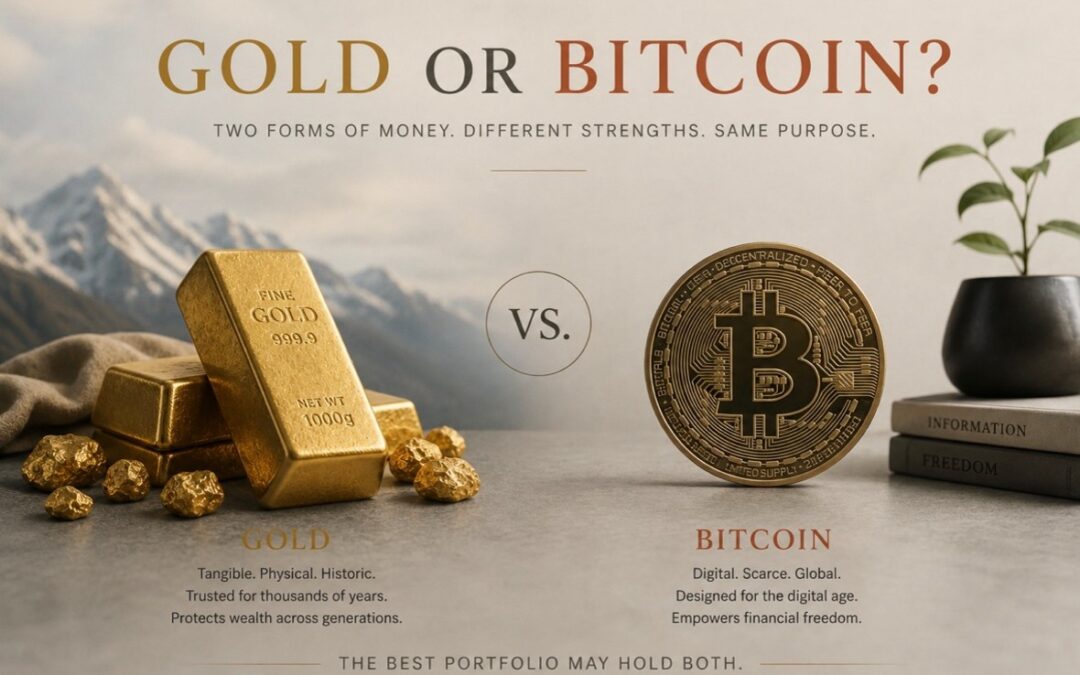
Two forms of scarce money, separated by thousands of years of technology.
I recently had a conversation with an older friend about Bitcoin. He and his wife have owned gold for years and have done rather well from it. He understands why people own it.
Gold is scarce. Nobody can print it. It has survived currencies, governments, wars and financial crises.
He was considering putting a relatively modest amount into Bitcoin not because he suddenly wanted to become a cryptocurrency trader, but because he wanted some exposure and, more importantly, to understand it.
His wife wasn’t so sure. Her concern wasn’t particularly about Bitcoin’s monetary argument.
It was technology. Exchanges. Passwords. Selling. Transferring money. Making a mistake.
And that struck me as an important distinction.
Sometimes when people compare gold and Bitcoin, the discussion quickly degenerates into two camps shouting at one another.
- Gold is ancient.
- Bitcoin is the future.
- Gold is a barbarous relic.
- Bitcoin is imaginary internet money.
None of that is particularly useful. Perhaps the more interesting question is:
What are gold and Bitcoin actually trying to do?
Gold solved an ancient problem
For thousands of years, humans searched for reliable ways of storing the fruits of their labour. Eventually gold emerged as one of humanity’s most successful monetary assets.
And for good reason. Gold is durable. It doesn’t rot. It is difficult to produce. It is recognisable. It can be divided. It cannot be manufactured at will. And importantly, if you physically possess gold, there is no company standing between you and the asset.
Nobody else’s promise is required for your ounce of gold to remain an ounce of gold. That is an extraordinarily powerful property. It is one reason gold has survived thousands of years of monetary experimentation.
Bitcoin shouldn’t require us to pretend otherwise.
So what problem is Bitcoin trying to solve?
Bitcoin starts with many of the characteristics that made gold attractive and asks a distinctly 21st-century question:
Can scarcity exist digitally?
Before Bitcoin, this was extremely difficult.
- A photograph can be copied.
- A document can be copied.
- An MP3 can be copied.
Anything digital can normally be duplicated almost perfectly at virtually zero cost.
Money therefore required trusted intermediaries to prevent people spending the same digital money twice.
Banks maintained the ledgers. Payment companies moved the balances. Central banks ultimately anchored the system.
Bitcoin proposed something different.
A distributed network could maintain a ledger without one central institution controlling it, while ensuring that the digital asset recorded on that ledger could not simply be duplicated.
That was the breakthrough. Bitcoin didn’t make gold obsolete.
It attempted to give digital property some of the scarcity characteristics humanity had previously found primarily in the physical world.
Gold has something Bitcoin cannot manufacture
History. Gold has been valued across civilisations for thousands of years.
Bitcoin has existed since 2009.
Seventeen years is impressive for a technology that began as an obscure experiment posted to a cryptography mailing list. But seventeen years is not five thousand years.
Nobody can honestly guarantee what Bitcoin will look like fifty or one hundred years from now. Gold, meanwhile, has already survived enormous technological, political and monetary changes.
That track record deserves respect. For a conservative saver, particularly an older one, that matters.
Bitcoin has something gold struggles with
Portability.
Imagine trying to move £1 million worth of gold from London to Singapore.
It can certainly be done. But you’re going to need transport, insurance, security, paperwork and probably several intermediaries.
Now imagine transferring £1 million worth of Bitcoin.
The value itself doesn’t physically travel anywhere. Ownership recorded by the Bitcoin network changes. Subject to network conditions and the way the transaction is structured, substantial value can be transferred globally without transporting a physical object across a border.
That is an extraordinary property. Gold was excellent money for a physical world.
Bitcoin was designed for a digital one.
Divisibility
Gold can obviously be divided. But there are practical limits. Nobody is going into a coffee shop and shaving £4.50 worth of gold from a bar.
Bitcoin is inherently divisible. One bitcoin contains 100 million satoshis. You don’t need to buy a whole bitcoin.
You can own £50 worth, £500 worth or considerably more. The unit price of one bitcoin therefore tells us surprisingly little about whether Bitcoin is accessible to ordinary investors.
It is simply a unit of measurement.
Supply
This is probably Bitcoin’s strongest monetary argument.
Gold is scarce, but its supply isn’t absolutely fixed. When gold becomes more valuable, there is greater incentive to find and mine more of it.
We don’t know precisely how much gold remains underground or what future extraction technologies might make possible.
Bitcoin operates differently.
Its issuance schedule is predetermined and its ultimate supply is limited to approximately 21 million bitcoin. Increasing the amount of computing power devoted to mining doesn’t increase that limit.
Bitcoin therefore offers something unusual:
scarcity whose rules can be independently verified.
Gold’s scarcity comes from geology.
Bitcoin’s scarcity comes from consensus and code.
Both are scarce.
But they are scarce for very different reasons.
Where gold is much easier
There is another side to this argument that Bitcoin enthusiasts sometimes underestimate.
Technology creates risk.
An elderly person who owns physical gold and knows where it is may understand their asset perfectly well.
- They know what it looks like.
- They know roughly what it is worth.
- They understand how it can eventually be sold.
Bitcoin introduces an entirely different vocabulary.
- Wallets / Multisig Wallets
- Private keys.
- Seed phrases.
- Two-factor authentication.
- Transaction fees.
- Hardware devices.
For somebody comfortable with technology, these things can become straightforward.
For somebody who isn’t, they can be intimidating.
And that matters.
There is little point owning a theoretically superior asset if you are terrified to touch it.
Custody matters
Physical gold has its own custody problems.
- Where do you keep it?
- At home?
- In a bank?
- In a professional vault?
- Who knows it exists?
- What happens if you die?
Bitcoin asks many of the same questions, only in a different form.
- Keep bitcoin on an exchange and you are trusting the exchange.
- Take personal custody and you assume responsibility for protecting the keys required to access it.
- Lose those keys without an appropriate backup and nobody can simply reset your password.
That is simultaneously one of Bitcoin’s greatest strengths and one of its greatest challenges.
True ownership comes with true responsibility.
For younger generations who have spent their lives operating digitally, that transition may feel natural.
For someone in their seventies or eighties, it may not. That doesn’t make them foolish. It means the solution has to fit the person.
Volatility cannot be ignored
Bitcoin is considerably more volatile than gold. Its price has repeatedly risen dramatically and then fallen 50%, 60% or more. Anyone considering owning Bitcoin needs to understand that before buying it.
If seeing £10,000 become £5,000 would cause you to panic and sell, your allocation was probably too large or Bitcoin may simply not be appropriate for you.
Gold tends to behave much more sedately. That can look boring during Bitcoin bull markets. It can look rather attractive during Bitcoin crashes. Again, different assets can perform different jobs.
Perhaps it isn’t Gold versus Bitcoin
This is where I think the debate becomes unnecessarily tribal.
Gold owners already understand much of the argument behind Bitcoin. They understand scarcity. They understand monetary debasement. They understand why an asset without an issuer can be valuable. They understand why preserving purchasing power can matter more than generating excitement.
Bitcoin doesn’t necessarily require them to abandon those beliefs. In many ways, it asks them to extend the same reasoning into the digital world.
- Gold has thousands of years of history.
- Bitcoin has digital portability.
- Gold has physical independence.
- Bitcoin has mathematically constrained supply.
- Gold requires physical custody.
- Bitcoin requires digital custody.
- Gold has proven itself across centuries.
- Bitcoin remains a relatively young monetary experiment.
You don’t necessarily have to declare one the winner.
The technology matters as much as the investment
This is particularly important for older investors.
Before deciding how much Bitcoin someone should own, there is another question I think matters far more:
Could they confidently look after it?
- Could they access their exchange account?
- Could they use two-factor authentication?
- Could they recognise a scam?
- Could they transfer Bitcoin without panicking?
- Would their husband, wife or children know what to do if something happened to them?
If the answer is no, those problems should be addressed before the size of the investment is discussed. Understanding should come before allocation.
Because owning an asset you cannot confidently access isn’t financial independence. It’s another form of dependency.
Two different forms of scarcity
Gold isn’t going away. And I don’t think Bitcoin needs gold to disappear in order to succeed.
Perhaps they ultimately serve overlapping but slightly different purposes. Gold represents thousands of years of human experience discovering that wealth can be preserved in something difficult to produce.
Bitcoin represents an attempt to bring that same principle of scarcity into a world in which increasingly everything else has become digital.
- One was discovered.
- The other was engineered.
- One relies upon geology.
- The other relies upon mathematics, cryptography, energy and a global network of participants.
Both ask essentially the same question:
Where can I store the value of work I’ve already done without somebody else being able to create more of it easily?
Gold has been answering that question for thousands of years. Bitcoin has only just begun.
Perhaps neither gold nor Bitcoin should first be thought of as an investment. Neither produces anything. Their primary monetary proposition is simpler: can they preserve the value of work already done?