
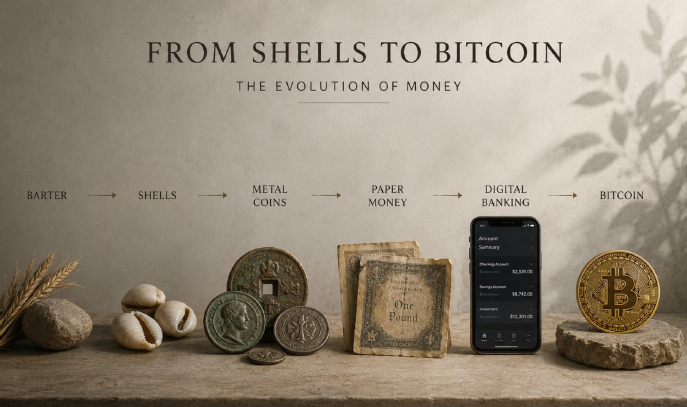
The Evolution of Money
Money is one of the oldest technologies ever invented.
We use it every day. We earn it, spend it, save it and invest it. Yet very few of us ever stop to ask where it came from, why it keeps changing, or whether the money in our pocket today is fundamentally different from the money our parents and grandparents used.
The truth is that money has never stood still.
Throughout history, every new form of money solved a problem created by the one before it. As trade expanded and societies became more sophisticated, money had to evolve alongside them.
Perhaps Bitcoin is simply the latest chapter in a story that began thousands of years ago.
When Trade Was Simple
Long before coins, banknotes or bank accounts existed, people exchanged goods directly with one another. Grain, salt, cattle, feathers, cowrie shells and beads have all served as money at different points in history.
This system, known as barter or commodity money, worked well in small communities where people knew one another. But it had obvious limitations. What if the farmer wanted shoes but the shoemaker didn’t need grain?
As societies grew, people needed something that everyone recognised as valuable. Money had taken its first step.
Keeping Track
As communities expanded, people also needed ways to record who owed what.
Different cultures developed their own solutions, including tally sticks and even enormous Rai stones on the Pacific island of Yap. These weren’t part of a single worldwide progression, but they illustrate humanity’s search for better ways to represent and record value.
These systems helped facilitate trade, but they were often cumbersome, difficult to transport and open to manipulation. Something better was needed.
The Age of Metal
People gradually began using copper, silver and gold because they possessed qualities that made them excellent forms of money.
- They were durable.
- Divisible.
- Portable.
- Recognisable.
- Scarce.
Initially, metal was traded in ingots or nuggets that had to be weighed for every transaction.Imagine buying a loaf of bread and waiting while the merchant weighed your silver before agreeing on its value.
It worked. But it wasn’t practical.
Around 650 BC, the Kingdom of Lydia introduced some of the first widely recognised coins made from electrum, a naturally occurring alloy of gold and silver.
Soon afterwards, the Greeks refined the concept further, minting standardised silver coins that transformed trade throughout the Mediterranean.
Over time, different metals naturally found different roles.
- Gold became the money of large wealth and international trade.
- Silver became the backbone of everyday commerce.
- Copper and bronze handled smaller daily purchases.
For the first time, money had become standardised.
When Trust Became a Problem
Wherever valuable coins existed, human ingenuity soon found ways to exploit them. Some people clipped tiny amounts from the edges of silver and gold coins, keeping the precious metal while continuing to spend the lighter coin at full value.
Governments later adopted a different approach. Rather than clipping coins, some rulers reduced the amount of precious metal inside them while keeping the same face value. This practice became known as debasement.
The lesson was already becoming clear. The value of money depends not only on what it is made from, but also on the trust people place in it.
Paper Changes Everything
Transporting large quantities of metal was inconvenient and dangerous.
Around the 7th century, merchants in China began using paper receipts instead of carrying heavy strings of bronze coins. During the Song Dynasty, these receipts evolved into the world’s first government issued paper money.
Initially, each note represented a claim on real metal held elsewhere. The paper itself wasn’t the money.
It was simply a receipt for the money.
Europe Discovers Paper Money
Europe arrived at the same idea several centuries later. The process happened in three important stages.
Stage One – Goldsmiths
People deposited their gold with trusted goldsmiths for safekeeping and received a paper receipt confirming ownership.
Stage Two – Receipts Become Money
People soon realised it was easier to exchange the receipt than continually collect and transport the gold itself. The receipt began circulating as money.
Stage Three – Banking
Banks noticed something interesting. Very few customers collected all of their gold at the same time. This allowed banks to issue more paper receipts than the gold they actually held, creating what eventually became the foundation of fractional reserve banking.
Money had evolved again.
The Gold Standard
The Bank of England, founded in 1694, issued banknotes that promised to pay the bearer in gold. For centuries, many banknotes explicitly stated that they could be exchanged for a fixed quantity of precious metal.
The paper wasn’t the money. It represented a claim on the money. This system became known as the gold standard.
The Beginning of Fiat Money
The First World War placed enormous financial strain on governments.
Britain temporarily suspended gold convertibility in 1914 because financing the war required far more money than its available gold reserves could support.
After the Second World War, the global monetary system was redesigned.
At the 1944 Bretton Woods Conference, participating nations agreed to peg their currencies to the US dollar, while the dollar itself remained convertible into gold.
This arrangement provided stability for several decades. But it depended on trust.
As the United States increased spending on overseas commitments, social programmes and economic growth, more dollars entered circulation than could realistically be redeemed for gold.
Foreign governments increasingly requested their gold and thus American gold reserves declined.
In 1971, President Richard Nixon suspended the dollar’s convertibility into gold.
This became known as closing the gold window. From that moment, the world’s reserve currency became a fiat currency. Not because gold had disappeared. But because the promise to exchange dollars for gold had ended.
Money was now backed primarily by confidence in governments and central banks rather than a physical commodity.
The Digital Revolution
Technology changed money once again. Today, most of our salaries are deposited electronically. We pay using debit cards, credit cards, online banking, contactless payments and mobile wallets such as Apple Pay.
Very little physical money actually changes hands. Instead, banks simply update digital ledgers. In many respects, we have already been living with digital money for decades.
The Next Chapter
Money has evolved from shells to metals. From metals to paper. From paper to electronic ledgers. Each step solved problems that the previous system could no longer solve.
Every generation has inherited a different form of money from the one before it. Which brings us to an interesting question.
If money has never stopped evolving, why would we assume it has reached its final form?
Bitcoin, introduced in 2009, proposes a different answer to that question.
For the first time, it became possible to own and transfer a digitally scarce monetary asset without relying on a central issuer or intermediary.
Whether Bitcoin ultimately becomes the next chapter in the history of money remains to be seen.
But understanding Bitcoin begins with understanding something much older.
The story of money itself.